Arrival and translation
Buddhist ideas and communities entered China gradually during the Han period and the centuries that followed, through overland and maritime networks linking India, Central Asia and East Asia. Monks, merchants and envoys carried texts and images, while Chinese pilgrims later traveled west in search of teachings and manuscripts.
Translation was creative intellectual work. Translators had to find language for unfamiliar concepts, and early choices drew on existing Chinese vocabularies. Teams compared manuscripts, debated meaning and produced versions that shaped how later readers understood Buddhist philosophy and practice.
Schools in a Chinese setting
Chinese Buddhism developed traditions associated with particular texts and practices. Tiantai organized teachings around the Lotus Sutra; Huayan drew on the Flower Garland Sutra; Pure Land traditions emphasized devotion to Amitabha Buddha; Chan became known for lineages centered on meditation and direct insight.
These labels simplify a more connected world. Monasteries could transmit several forms of learning, and practitioners did not always belong to one exclusive school. Changes in patronage, printing, pilgrimage and state policy affected which institutions flourished in a given period.
Monasteries, learning and society
Monasteries served religious communities, preserved texts and images, trained clergy and participated in local economies. Some became major landholders or centers of patronage; others were small and local. Their relationship with imperial courts alternated among support, regulation and suppression.
Buddhist vocabulary entered literature, ethics and everyday speech. Monastic communities also interacted with lay donors, families and associations. The tradition’s social history is therefore broader than the biography of famous monks or the doctrines recorded in canonical texts.
Art and sacred geography
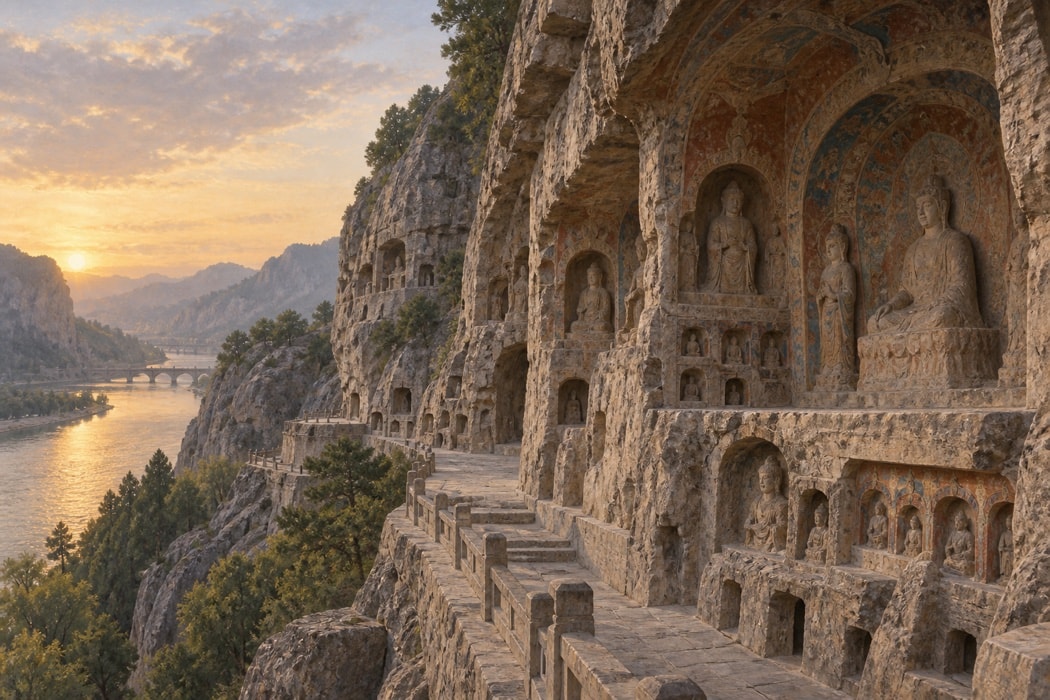
Cave temples, sculpture, murals, printed sutras and ritual objects document Buddhism’s movement across regions. Sites such as Yungang, Longmen, Dunhuang and Dazu reveal different periods of patronage and changing artistic languages. Imported forms were repeatedly adapted by local makers.
Mountains and pilgrimage routes became important religious geographies. Architecture placed halls, images and landscape in relation to movement through a site. Museum timelines help connect these objects to the political and artistic worlds in which they were produced.
Buddhism and the three teachings
Buddhist thinkers debated Confucian and Taoist ideas while also borrowing Chinese terms and literary forms. Chan histories often use Taoist-sounding language, but resemblance should not erase distinct institutions and teachings. Neo-Confucian thinkers later developed arguments partly through sustained engagement with Buddhist philosophy.
Buddhism in China is neither a foreign layer that remained unchanged nor an isolated national creation. It is a history of travel, translation, adaptation and debate. The wider religions index and the Tibet guide show two different settings in which Buddhist traditions developed.
Texts, canons and print
Chinese Buddhist canons assembled translations, commentaries and works composed in East Asia. Catalogues helped readers identify texts and competing translations. Woodblock printing made large projects possible and connected religious institutions with the history of the book.
A scripture title does not always point to one stable object. Manuscripts, printed editions and translations may preserve different readings. Study of colophons, paper, format and catalogues helps establish when and where a text circulated.
These textual histories also show the scale of collaboration. Translation and publication depended on patrons, scribes, editors, artisans and institutions as well as celebrated monks. Buddhism’s intellectual history is inseparable from that material work.
Fragments recovered from cave libraries and archaeological sites can preserve texts absent from later standard editions. Their scripts, repairs and reuse expose the everyday life of manuscripts. Such finds remind readers that a canon is both an idea and a changing collection of physical objects.
Sources & further reading
- Metropolitan Museum’s art-history timeline — Art and chronology